-
Dr Marie Skepö (Div. of Theoretical Chemistry, Dept. of Chemistry, Lund University, Sweden)Oral
Intrinsically disordered proteins (IDPs) lack well-defined three-dimensional structure in solution under physiological conditions. Despite this they are functional and participate in the regulation of many biological processes, in which disorder can enable interactions of high specificity coupled with low affinity. Phosphorylation is one of the most abundant types of post-translational...
Go to contribution page -
Adrien Favier (IBS CNRS)Oral
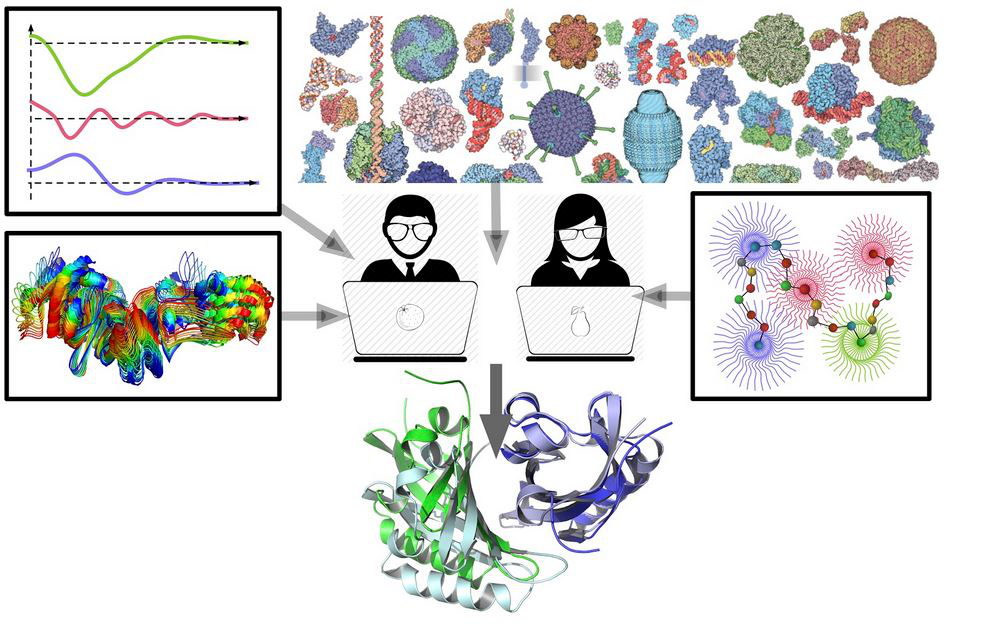
Atomic-resolution structure determination is the key requirement for understanding protein function. Cryo-EM and NMR spectroscopy both provide structural information, but currently cryo-EM does not routinely give access to atomic-level structural data, and, generally, NMR structure determination is restricted to small (<30 kDa) proteins. We introduce an integrated structure determination...
Go to contribution page -
Dr Francois FERRON (Architecture et Fonction des Macromolécules Biologiques, AFMB - CNRS)Oral
In the recent years a massive amount of raw viral genomic data has been produced and released in sequenced databases, leading to the paradoxical situation of generating the Domain of Unknown Function (DUF), the number one domain in knowledge databases. Together with bio-informatics prediction, the knowledge of the three-dimensional structures of DUF proteins is the key to unveil the full...
Go to contribution page
Choose timezone
Your profile timezone: