(Latest update on Friday, 13th of March 2026)
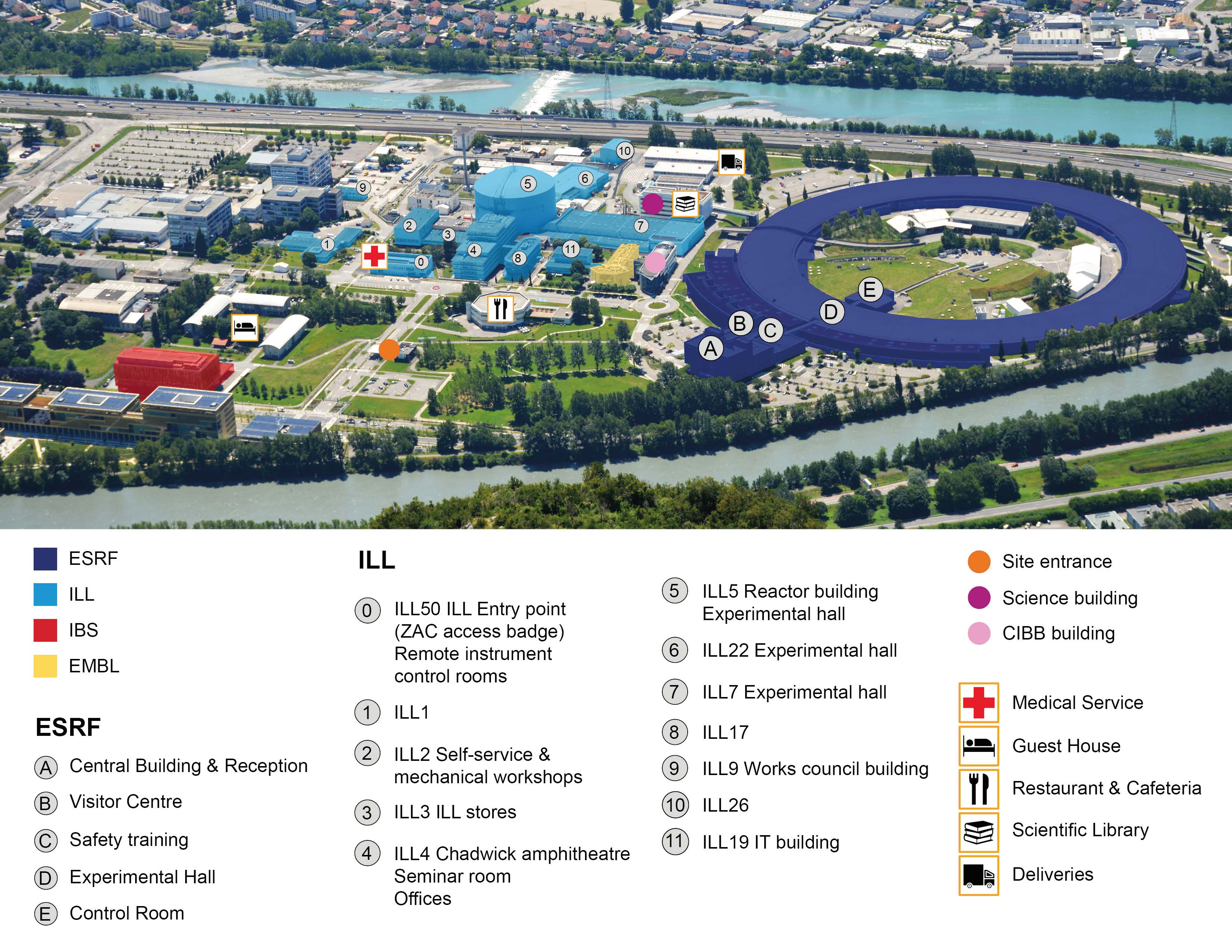
Please remember to take your ID card or passport to the EPN site entrance with you (marked in orange on the map below) in order to pick up your site badge. Driving licenses are not accepted as valid forms of ID. We advise you to arrive in plenty of time at the site entrance.
Once you have picked up your badge, you will need to go to "ILL50" ("0" on the map below), where the workshop will take place. Upon arrival, you can pick up your name badge, which can be used to pay for your lunch at the canteen.
Tables have been reserved for GISANS the conference at the back of canteen, with tea and coffee machines available after for you to help yourselves (on the tables behind).
***********************************************************
(update on Thursday, 12th of March 2026)
The workshop will take place at ILL50 (1st floor). It is organized with only a few longer talks on topics concerning GISANS data analysis. Other useful information such as a site map can be found on this page.
(1) Introducing discussion: People who have interest in particular challenges have been asked to provide short presentations on specific areas. These are talks identified as "Introductions". They have been asked to identify points to discuss during subsequent breakout sessions and to define ways to drive forward appropriate developments.
(2) Structure of breakout groups: Each breakout group will consist of 5-6 participants (onsite or online) but this can be flexible depending on who is present. We hope that everybody will try and contribute on all topics, but if particular groups want to discuss longer and provide more in-depth feedback on particular topic(s) this will also be possible. Each breakout group will have a "chair" and a "rapporteur", both being onsite participants. The "chair" will ensure that discussions flow within the allocated time. The "rapporteur" for each breakout group will prepare notes in the canSAS wiki webpage. Therefore, all participants are kindly asked to create an account on the canSAS webpage.
https://wiki.cansas.org/index.php?title=Special:RequestAccount
These roles will be assigned to participants during the meeting.
We expect that this workshop will plan specific ways to make progress in the coming period and identify what needs to be done and who will contribute to on-going activities.
Zoom links for remote participation will be sent next week (starting from Monday, 16th of March 2026). We look forward to meeting you in Grenoble next week.
Best regards,
The Organizing Committee
Emily Ryan (ILL), Apostolos Vagias (ILL), Annika Stellhorn (ESS), Adrian Rennie (Uppsala University)
****************************************************************
Registration deadline has been extended until 20 February 2026 at 9:00 AM.
Please note that the option to book accommodation is no longer available, as the accommodation deadline (13 February 2026) has now passed.
* Please note that all registrations are subject to approval from the organising committee. If maximum numbers are reached, we may have to decline further registrations. *
_________________________________________________
GISANS Data Reduction and Analysis Upgrades Initiative:
An initiative on “GISANS data reduction and analysis upgrades” was launched at the GISAXS 2025 workshop in Hamburg during November 2025. The objective of the initiative is to develop a generic, instrument-independent software framework for GISANS data reduction and analysis that can be used across neutron research facilities.
Approach:
The proposal is to build upon the open-source software package BornAgain and to identify and define the key developments required for broader GISANS usability. Planned areas of improvement include:
- more flexible treatment of instrument resolution,
- improved background subtraction,
- clearer approaches to normalization,
- increased interoperability with existing analysis and reduction software tools.
Planned Work:
A dedicated working group has to be established with two primary tasks: 1. Defining a roadmap and priority list for the required functionality. 2. Implementing these features in collaboration with the BornAgain core development team. Contributions may include code development, example scripts, and other shared resources.
Next Steps:
The GISANS community is being invited to participate in the initiative. A first workshop is planned for the first half of 2026, with Institut Laue-Langevin (ILL) proposed as the host venue. The meeting is intended to be held on-site, with the option for remote attendance.
Link to details:
/GISANS Data Reduction and Analysis Upgrades Initiative
