Understanding the microstructure of complex fluids across multiple scales is essential for building predictive models. While Small Angle Scattering - using neutrons at ILL or X-rays at ESRF - provides invaluable data, fitting individual scattering profiles that have often few features may yields numerical outputs rather than deep physical insights. A paradigm shift occurs when integrating complementary techniques: By combining SAXS, SANS, static and dynamic light scattering with Molecular Dynamics or random Gaussian wavelets simulations, researchers can achieve robust, quantitative analyses—especially when thermodynamic principles, such as those evoked by Maxwell's demon, are incorporated.
This symposium will explore advanced methodologies that bridge scattering techniques with enthalpic and entropic considerations, enabling the development of practical modeling strategies. We will highlight breakthroughs in critical applications, from innovative recycling separation processes to the design of biomimetic colloids with antiviral potential.
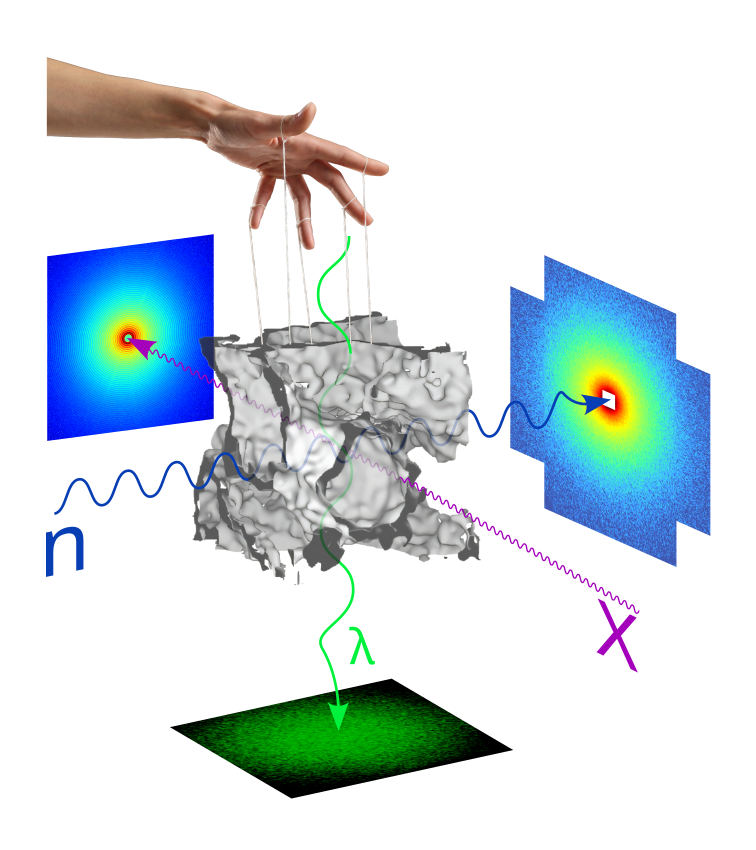
Biliquid foam structure can be observed by neutrons, X-rays and light. Thermal fluctuations controlling the stability are symbolised by the hand of a Maxwell's daemon.
The workshop will also include a special session to honor the career and contributions of Thomas Zemb, a pioneer in the field of colloids and their application in recycling and green processes, as he is moving to an emeritus status 53 years after his first publication with Francis Perrin. In the late 70s, Thomas was building a high sensitivity lab-SAXS as well as a high-resolution USAXS at CEA/Saclay with the help of André Guinier, the father of small-angle X-ray scattering. Later he joined ILL for a year as a technician where he participated in the first experiments on interacting charged surfactant micelles analyzed in absolute scale with both SANS (D11, D17) and SAXS under the supervision of John B Hayter, with Luc Belloni establishing theoretical expressions. In the early 90s, he together with Joan Bordas and Heinrich Stuhrmann advocated for the selection of ID01 and ID02 beamlines at the ESRF. With Peter Lindner, he co-founded the Bombannes summer schools. As the founding director of the Institut de Chimie Séparative de Marcoule (ICSM), he advanced the characterization of colloidal systems through modern colloid science, enhancing separation processes fundamental to hydrometallurgy. His former students and post-docs have used the stereoscopic approach combining X-ray, neutron and light scattering with thermodynamics and simulations. This has led to key progresses in physics, chemistry, biophysics and technology, that will be discussed in this workshop.
