Speaker
Description
The literature indicates that the water surface is negative even at bulk pH well below 7. Our instrument excites, and is able to detect, the capillary modes of macroscopic bubbles with oscillations of minimal amplitude. The surface undulations are amplified at resonance by e.m. waves of 0.2 - 20 V/cm, reaching figures in the range of 0.5-20 nm ($10^{-6}$ times the bubble size). The bubble response originates from the interference of the two beams reflected from the opposite bubble interfaces when an incoming laser beam crosses its diameter. The amplitude of capillary oscillations depends on the bubble’s effective charge at nanometric distances from the surface. Effective charge sign is detected by the Cross spectrum between exciting e.m. field and interferometric response (Figure 1). Outcomes are a) in-phase response maintained from neat water to negative SDS coated bubbles, b) null response seen when the right number of positive DTAB molecules adsorb on a bare bubble, c) basic solutions show in-phase response of increasing amplitude when bulk pH increases and d) acidic bulk solutions show in-phase response down to bulk pH < 3, where it changes to out-of-phase response due to effective charge sign changed from negative to positive.
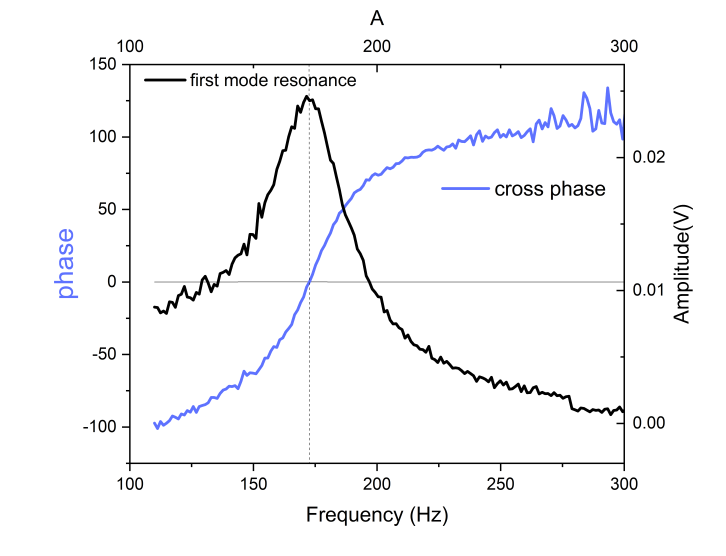
Figure 1. Cross spectrum between exciting e.m. field and interferometric signal (blue) for the first resonance of the capillary mode (black).
