Speaker
Description
Combining modalities enables revealing the complexity of matter. After having learnt this lesson from Thomas Zemb while studying colloidal systems with him in the years 2000, i later applied it to completely different fields of research – the latter being the operando investigation of battery materials. In this talk i will emphasize the advantages and necessity of SAXS/SANS techniques coupled to other tools as electrochemical methods, neutron/x-ray imaging, or spectroscopic techniques, to visualize and quantify nanoscale changes that happen in electrolyte and electrode materials during device cycling, and their link to the battery performance and longevity. Nanostructured materials as single-ion conducting polymers, nanoengineered silicon-based negative electrodes or hard carbon composites, are key components of emerging technologies for better, safer and more sustainable Li-ion and Na-ion batteries. Synchrotron methods as fast scanning SAXS and SAXS-computed tomography techniques$^1$ are needed to uncover the extended spatiotemporal spaces where multiple reaction and degradation phenomena that happen in a working battery.
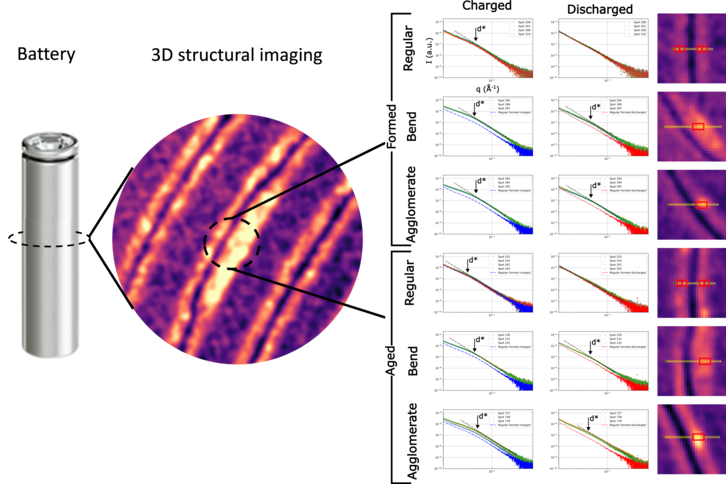
Figure 1. 3D imaging of the interior of a battery using SAXS-CT, enabling to reveal specific defects and areas not lithiating correctly due to active material aggregation$^1$.
1: E. Lübke et al, Energy Environ. Sci. 17, 5048-5059 (2024)
