FASEM 2026

Europe/Paris
ILL4/rdc-1 - Amphi Chadwick (ILL4)

ILL4/rdc-1 - Amphi Chadwick

ILL4

110
Description

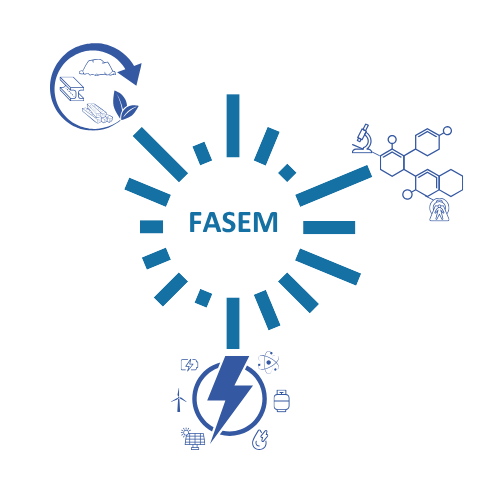
The FASEM is a recurring biennial advanced-school, rotating across three key thematic areas: Scattering Techniques for Environment & Materials, Life Sciences, and Energy Applications. Its goals are to prepare the future generation of users of large-scale facilities for synchrotron and neutron scattering; develop and strengthen sustainable scientific exchanges between the French and Swedish communities on the use of large-scale facilities, in connection with the forthcoming ESS commissioning; and strengthen the links between institutes in France (ILL, ESRF, SOLEIL) and in Sweden (MAX-IV, ESS).


TOPICS

  • Neutron and X-ray Techniques
  • Battery and Hydrogen Materials
  • Nuclear Materials and Fuel Cycle
  • Simulations and AI in Energy Research
  • Industrial Applications and Societal Impact
     

Scientific committee

  • Peter Fouquet, ILL
  • Gerardina Carbone, MAX IV
  • Fabrice Cousin, CEA
  • Celine Durniak, ESS
  • Pascale Launois, CNRS/SFN
  • Marie Plazanet, UGA
  • Valentin Vinci, ESRF
  • Max Wolff, UU 


Organising committee

  • Peter Fouquet, ILL
  • Christine Darve , (FASEM coord.) ESS
  • Victor Ducret, French Embassy
  • Yan Pautrat, French Embassy
  • Laurence Tellier, ILL
    • 09:00 09:30
      Registration 30m
    • 09:30 10:30
      Welcome address and presentation of ILL 1h ILL4/rdc-1 - Amphi Chadwick

      ILL4/rdc-1 - Amphi Chadwick

      ILL4

      110
      Speakers: Christine Darve (European Spallation Source ERIC), Ken Andersen (ILL), Peter Fouquet (Institut Laue-Langevin)
    • 11:00 12:30
      Introduction to X-rays and Neutrons for Materials Science and Energy 1h 30m ILL4/rdc-1 - Amphi Chadwick

      ILL4/rdc-1 - Amphi Chadwick

      ILL4

      110
      Speaker: Alekxandar Matic (Chalmers University of Technology)
    • 14:00 15:20
      An Introduction to Neutron and X-ray Imaging 1h 20m ILL4/rdc-1 - Amphi Chadwick

      ILL4/rdc-1 - Amphi Chadwick

      ILL4

      110
      Speaker: Alessandro Tengattini
    • 15:45 17:00
      ESRF welcome (Visitor Center) and visit 1h 15m ILL4/rdc-1 - Amphi Chadwick

      ILL4/rdc-1 - Amphi Chadwick

      ILL4

      110
      Speaker: Jean Daillant (ESRF)
    • 17:00 18:30
      Poster Session & reception (mezzanine ESRF) 1h 30m ILL4/rdc-1 - Amphi Chadwick

      ILL4/rdc-1 - Amphi Chadwick

      ILL4

      110
    • 09:00 10:30
      Neutron and X-ray Diffraction (for Energy Materials) 1h 30m ILL4/rdc-1 - Amphi Chadwick

      ILL4/rdc-1 - Amphi Chadwick

      ILL4

      110
      Speaker: Ove Korjus
    • 11:00 12:30
      Small Angle Scattering: Leaving Atoms Behind and Going Big 1h 30m ILL4/rdc-1 - Amphi Chadwick

      ILL4/rdc-1 - Amphi Chadwick

      ILL4

      110

      Many processes in energy materials do not only depend on the microscopic arrangement of atoms on the atomic scale, but are controlled by the gross characteristics and morphology of matter on the nano and microscale. Small-angle X-ray/neutron scattering (SAXS/SANS) allows to access these features giving insights into the size, shape, and arrangement of objects of few nanometers to several hundreds of nanometers. This lecture will introduce key concepts of small-angle scattering and give some examples on how SAXS and SANS can be used to study battery materials.

      Speaker: Xaver Brems (LSS)
    • 14:00 15:00
      Neutron spectroscopy 1h ILL4/rdc-1 - Amphi Chadwick

      ILL4/rdc-1 - Amphi Chadwick

      ILL4

      110
      Speaker: Michael Koza (Institut Laue Langevin)
    • 15:00 16:00
      Operando characterizations of batteries : from particles to devices 1h ILL4/rdc-1 - Amphi Chadwick

      ILL4/rdc-1 - Amphi Chadwick

      ILL4

      110

      Understanding key reaction and degradation mechanisms in batteries require to combine different characterization tools and obtain structural, chemical, morphologicak insights into the materials transformations, from the scale of individual active particles to the scale of a working commercial battery device. Neutrons and X-rays are particularly suited for this purpose. We will show some recent examples of their application in the field.

      Speaker: Sandrine Lyonnard (CEA-IRIG)
    • 16:30 18:00
      Materials for nuclear reactor and fusion plants 1h 30m ILL4/rdc-1 - Amphi Chadwick

      ILL4/rdc-1 - Amphi Chadwick

      ILL4

      110

      In this lecture, we will discuss what types of materials are used in nuclear fission and nuclear fusion reactors, how they are affected by the specific reactor environments, and how we can study their properties, characteristics, and evolution under operation and transient conditions. We will focus on materials close to the reactor cores that experience some of the harshest engineering conditions ever encountered. Intense radiation fluxes, high temperatures and temperature gradients, corrosive environments, and variable stress states affect these materials.

      We will discuss nuclear fuels, structural materials, and the specificities and commonalities between fission and fusion reactors and their materials, as well as current research and development efforts in the field. The lecture will provide students with a broad overview of the topic and will also include deep dives into certain specific materials, modelling and experimental subtopics. In particular, the use of diffraction techniques will be highlighted.

      Speaker: Prof. Pär Olsson (KTH)
    • 09:00 10:00
      X-ray spectroscopy 1h ILL4/rdc-1 - Amphi Chadwick

      ILL4/rdc-1 - Amphi Chadwick

      ILL4

      110
      Speaker: Prof. Valérie Briois (SOLEIL)
    • 10:30 11:30
      Neutron & X-ray Reflectometry 1h ILL4/rdc-1 - Amphi Chadwick

      ILL4/rdc-1 - Amphi Chadwick

      ILL4

      110

      Neutron and x-ray reflectometry are complementary methods that allow the study of thin films and interfaces. I will discuss the basic principles of reflectometry experiments and data analysis. From specular reflectivity density profiles long the normal of interfaces can be extracted, while off-specular and grazing incidence scattering provides information about in-plane correlations. Examples in hydrogen storage, magnetism and polymer science will be presented.

      Speaker: Maximilian Wolff
    • 11:30 12:30
      Hydrogen storage: Finite size and proximity effects 1h ILL4/rdc-1 - Amphi Chadwick

      ILL4/rdc-1 - Amphi Chadwick

      ILL4

      110

      Hydrogen will play a major role as energy carrier in the transition towards a sustainable and carbon dioxide emission free society. I will discuss the opportunities and challenges to store hydrogen. Emphasis will be on proximity and finite size effects, which allow to tune the absorption properties, specifically, the charging kinetics, gravimetric and volumetric capacity as well as efficiency of discharging.

      Speaker: Maximilian Wolff
    • 14:00 16:00
      ILL visit 2h ILL4/rdc-1 - Amphi Chadwick

      ILL4/rdc-1 - Amphi Chadwick

      ILL4

      110
    • 16:30 18:00
      Energy research in industry 1h 30m ILL4/rdc-1 - Amphi Chadwick

      ILL4/rdc-1 - Amphi Chadwick

      ILL4

      110
      Speakers: Jonas Okkels BIRK (Danish Technological Institute), Markus STROBL (PSI)
    • 18:00 20:20
      School dinner 2h 20m ILL4/rdc-1 - Amphi Chadwick

      ILL4/rdc-1 - Amphi Chadwick

      ILL4

      110
    • 09:00 10:00
      DFT Modelling 1h ILL4/rdc-1 - Amphi Chadwick

      ILL4/rdc-1 - Amphi Chadwick

      ILL4

      110
      Speaker: Elisa Rebolini
    • 10:30 11:30
      Artificial Intelligence in Data Analysis 1h
      Speaker: Dr Vincent Favre Nicolin (ESRF)
    • 11:30 12:30
      Neutron spectroscopy studies of perovskites for energy applications 1h ILL4/rdc-1 - Amphi Chadwick

      ILL4/rdc-1 - Amphi Chadwick

      ILL4

      110
      Speaker: maths karlsson (Chalmers University of Technology)
    • 14:00 14:45
      Preparation of Beamtime Proposals 45m ILL4/rdc-1 - Amphi Chadwick

      ILL4/rdc-1 - Amphi Chadwick

      ILL4

      110

      Preparation of Beamtime Proposals
      Peter Fouquet and the Lecturers

      Speaker: Peter Fouquet (Institut Laue-Langevin)
    • 14:45 15:30
      Adoption of Non-Sealed Radioactive Source Technologies and the Management of Disused Sealed Radioactive Sources (DSRS) 45m ILL4/rdc-1 - Amphi Chadwick

      ILL4/rdc-1 - Amphi Chadwick

      ILL4

      110

      Sealed Radioactive Sources (SRS) have long served as the standard means of delivering
      ionizing radiation across applications in medicine, research, public health, and industry.
      In recent years, however, advances in non-SRS based technologies have expanded the
      availability of viable alternatives capable of achieving equivalent, and in some cases
      superior, performance. While radioactive sources may remain the preferred option for
      certain cases, access to these alternative technologies potentially reduce the safety,
      security, regulatory, and end-of-life management obligations traditionally associated
      with sealed radioactive sources.
      Although the adoption of alternative technologies can reduce long-term reliance on
      radioactive materials, the transition from the traditional SRS-based technologies may
      also generate disused sealed radioactive sources (DSRS). These DSRS, depending on
      the isotope and activity, can remain dangerous for years to centuries and therefore
      require safe, secure, sustainable management that ultimately ends in disposal. Drawing
      on experiences from multiple States that have undertaken such transitions, this
      presentation highlights both positive outcomes and implementation challenges,
      emphasizing the need for coordinated planning and technical support mechanisms.
      The discussion will balance the assessment of technological, regulatory, and strategic
      considerations relevant to decision makers evaluating future equipment procurement
      and focus on DSRS management strategies. It also outlines current international eƯorts
      and assistance programs aimed at supporting States in assessing, adopting, and
      managing alternative technologies responsibly.
      Speakers: Christine Darve (European Spallation Source ERIC), Franck Cocina
    • 16:00 17:00
      Neutron Imaging for energy Applications 1h ILL4/rdc-1 - Amphi Chadwick

      ILL4/rdc-1 - Amphi Chadwick

      ILL4

      110

      In this lecture the potential of neutron imaging for energy applications will be outlined, including advanced neutron imaging techniques and their capabilities in the given context. Examples of a broad range of studies including but not limited to the fields of nuclear energy, batteries, and fuel cells will be provided.

      Speaker: Markus STROBL (PSI)
    • 17:00 19:00
      Student Clips 2h ILL4/rdc-1 - Amphi Chadwick

      ILL4/rdc-1 - Amphi Chadwick

      ILL4

      110
    • 09:00 10:00
      Societal impact of energy research 1h ILL4/rdc-1 - Amphi Chadwick

      ILL4/rdc-1 - Amphi Chadwick

      ILL4

      110
      Speaker: Prof. Heloise Goutte (CEA)
    • 10:30 12:00
      Round table: Energy research with an impact 1h 30m ILL4/rdc-1 - Amphi Chadwick

      ILL4/rdc-1 - Amphi Chadwick

      ILL4

      110
    • 12:00 13:00
      Closing remarks & Clip Awards 1h ILL4/rdc-1 - Amphi Chadwick

      ILL4/rdc-1 - Amphi Chadwick

      ILL4

      110